Turn messy data into decisions you can trust.

We clean, classify, and verify the records your business already runs on, then make them usable for reporting, workflows, and AI.

Important records sit across spreadsheets, documents, and systems. Different formats and versions force teams to clean the same data before every decision.

How the product works

From source records to operational decisions.

  1. Source records
  2. Validation
  3. Classification
  4. Human review
  5. Accepted data
  6. Operational decisions
  1. Ingest and verify

    We preserve the source, adapt to each format, and check rows, quantities, amounts, and totals.

  2. Classify and review

    AI interprets ambiguous records. People review, correct, and approve the result.

  3. Accept, use and expand

    Accepted data powers comparison, reporting, workflows, and management decisions.

Property development · Reference implementation

Turning thick Bills of Quantities into usable cost history.

Every project produced a dense, differently structured Bill of Quantities. The data existed, but it was difficult to compare or reuse for future cost control.

Arcshib AI grew from an AISEA Enterprise implementation for property-development cost data.

Close view of a completed residential facade.
High-rise residential development framed by trees.

The problem

Layouts, descriptions, and pricing versions differed from project to project. Valuable cost history remained trapped in individual workbooks, so each comparison required another round of interpretation.

What we built

The system imports each Bill of Quantities, organises priced items into consistent cost categories, checks arithmetic and source totals, then routes the result through human review and approval.

What it unlocks

Accepted data can be filtered, compared, and queried. The team can study cost drivers, compare pricing versions, trace answers to source records, and export structured workbooks to Excel.

What the system handles

  • Bills of Quantities with different layouts
  • Construction-cost classification
  • Arithmetic and source-total checks
  • Human approval and provenance
  • Comparison, plain-language analysis, and Excel export

A governed path from source to decision.

The interface keeps source handling, review, acceptance, and analysis visible as separate steps.
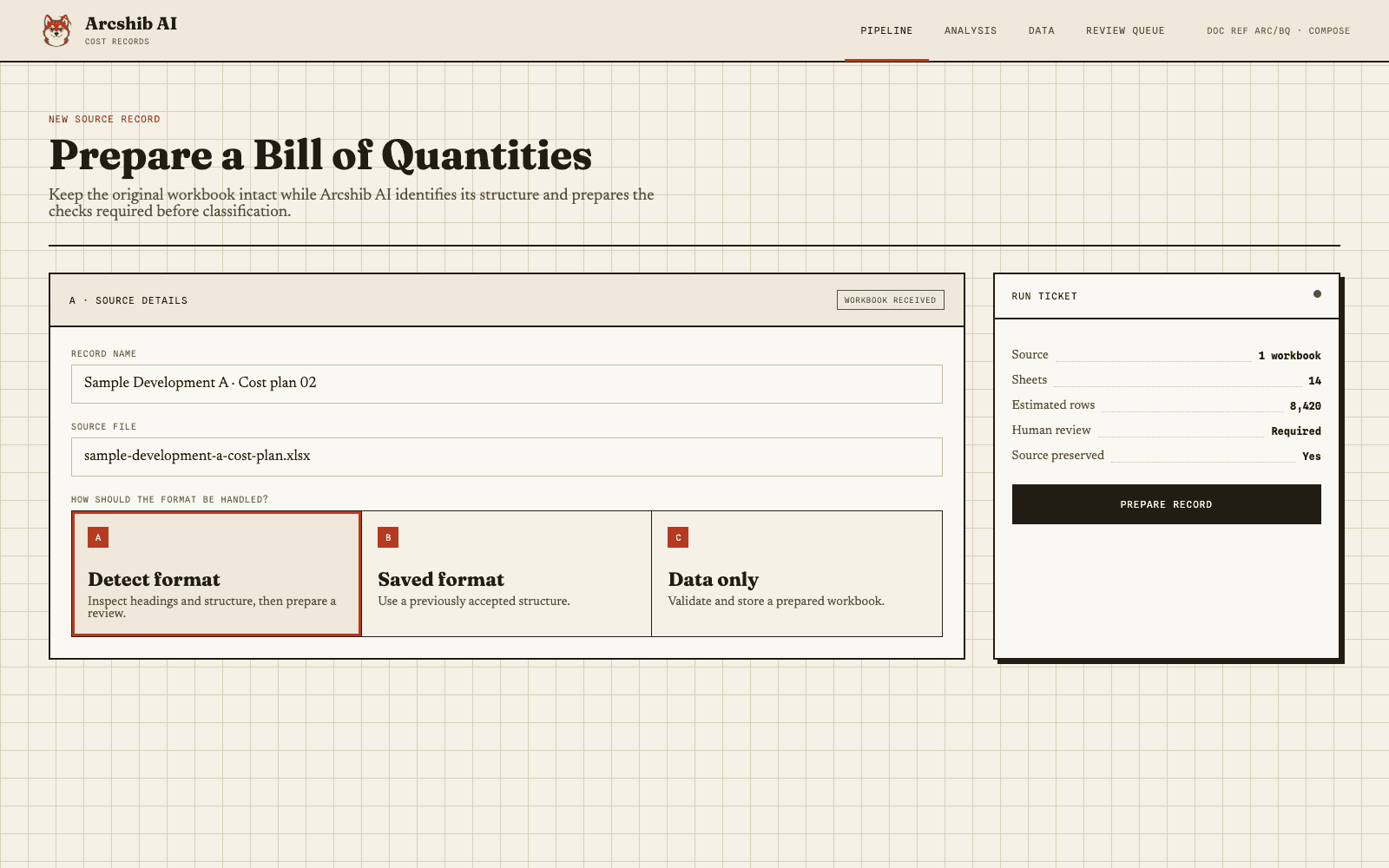
Representative Arcshib AI intake screen showing a synthetic Bill of Quantities ready for validation.
Source intake and validationPreserve the source, identify its format, and check the record before classification.Representative interface. Illustrative data.
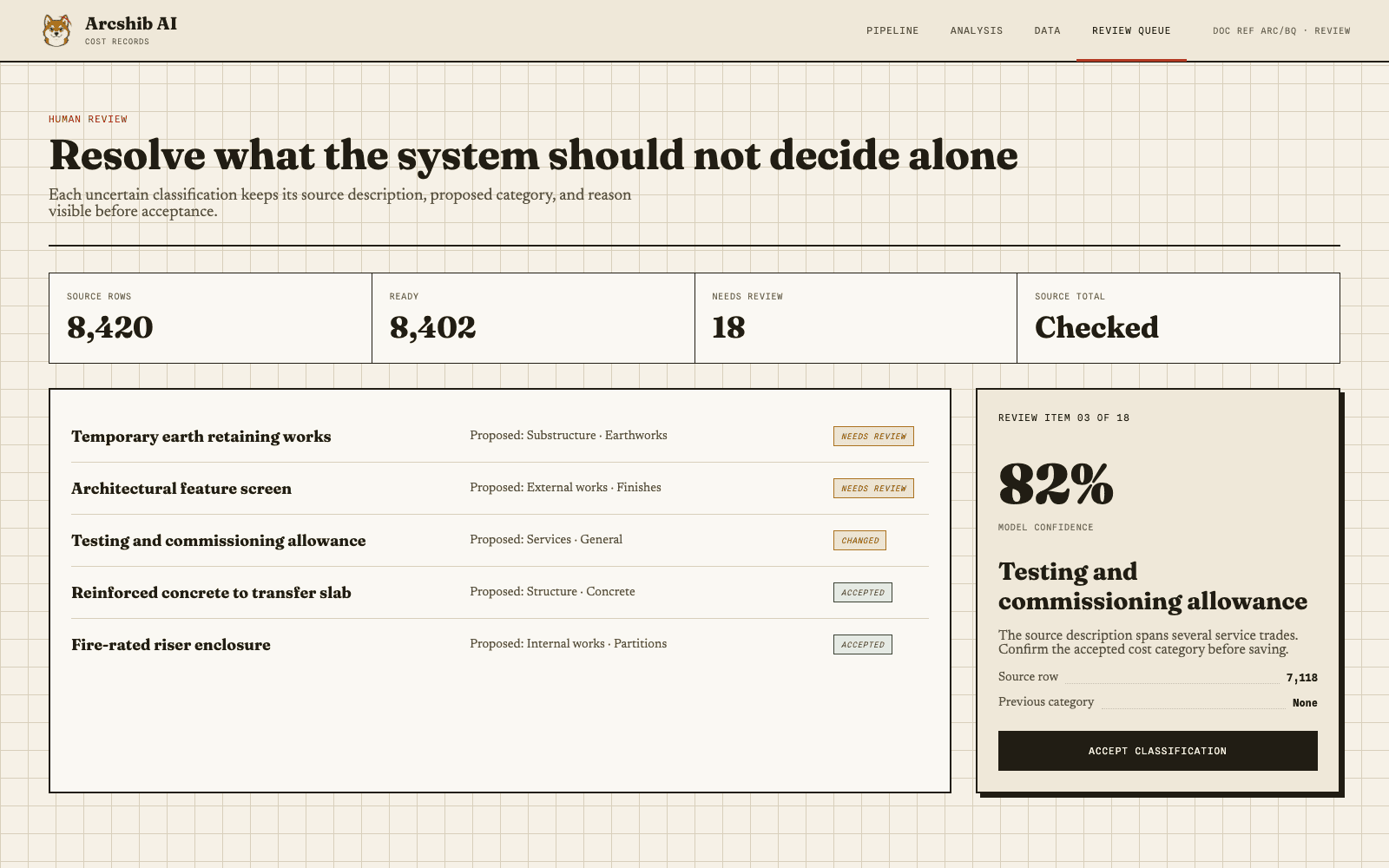
Representative Arcshib AI review screen showing synthetic classifications awaiting human acceptance.
Human review and acceptanceUncertain or changed classifications stay visible until an authorised person accepts them.Representative interface. Illustrative data.
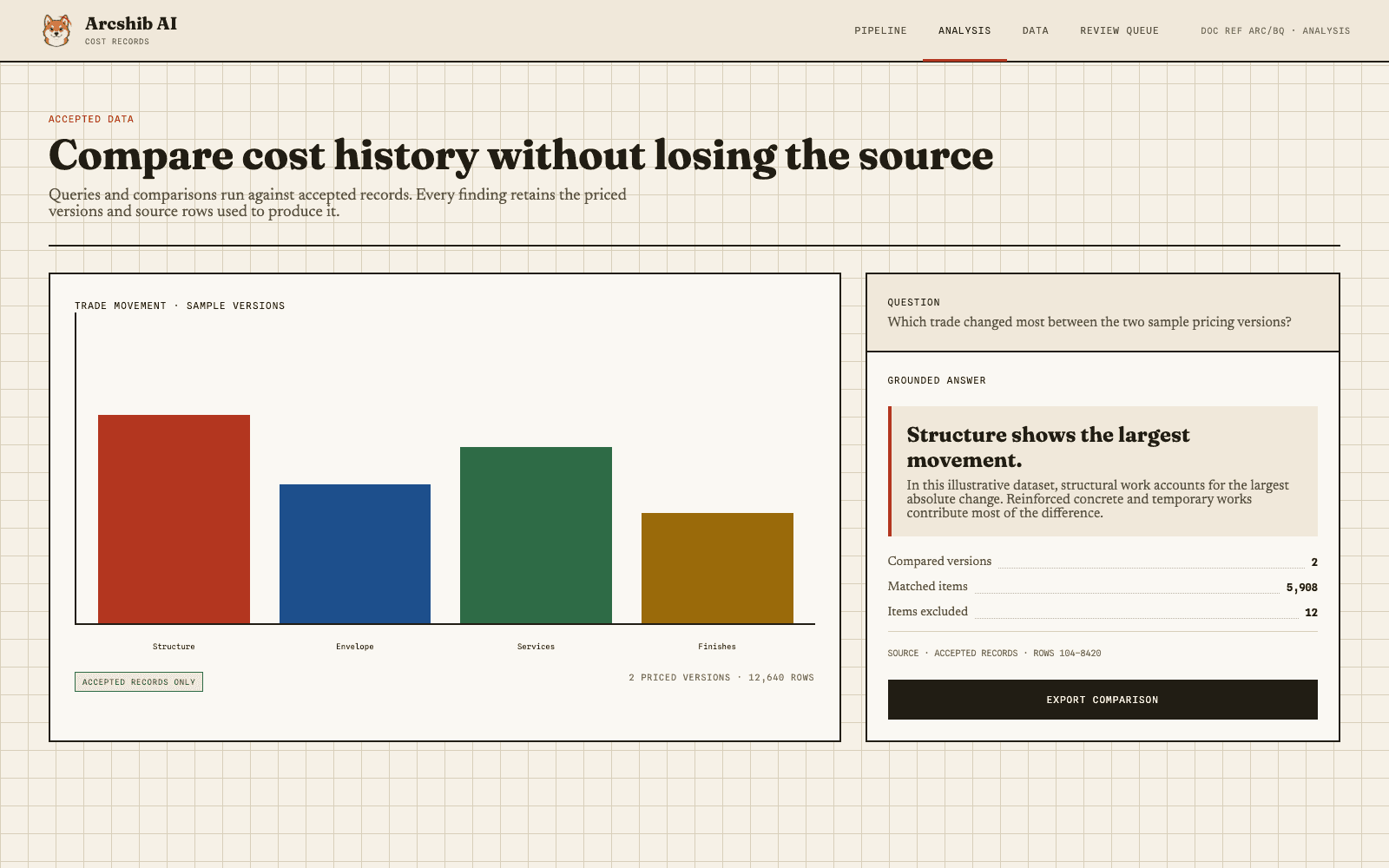
Representative Arcshib AI data screen comparing synthetic accepted cost records.
Accepted data and analysisAccepted records can support comparison, analysis, and export without losing their provenance.Representative interface. Illustrative data.

Where to start

Start with the workflow nobody trusts without checking twice.

Start with one decision-critical workflow the company repeatedly cleans, reconciles, or interprets.

  • Business-critical information is spread across spreadsheets, documents, or disconnected systems
  • Teams repeat the same cleaning and reconciliation before every report or decision
  • Categories, descriptions, or versions are too inconsistent for reliable comparison
  • Management needs traceable data and visible human approval before acting

How we work

Understand first. Deliver in operating context.

Most work starts with a paid Discovery & Audit. A validated scope can move straight into implementation.

  1. Understand

    We map the workflow, systems, data, decisions, constraints, and owners. The company receives a prioritised implementation direction.

  2. Deliver

    We build alongside operational owners, test with real users, and document the work against clear acceptance criteria.

  3. Expand

    Once the first system works, management chooses the next workflow or data source.

Embedded implementation

We work alongside the people who run the business.

A small team works alongside management and operational owners to deliver against clear acceptance criteria.

Leadership keeps control of decisions and the business.

  • Work with named management and operational owners
  • Understand the workflow before changing it
  • Build and test where the system will be used
  • Use authorised operating data
  • Document decisions and train users
  • Transfer knowledge during delivery

You retain the value created.

The company keeps its Discovery & Audit report.

Ownership, licensing, access, and third-party dependencies are agreed before implementation.

Accountability

Clear delivery commitments. Honest outcome boundaries.

We commit to clear scope, working systems, testing, handover, and honest evidence. Business outcomes are measured with management.

AISEA Enterprise owns

  • Delivery of agreed systems
  • Technical quality, testing, and integrations within scope
  • Agreed security and access requirements within scope
  • Documentation, handover, and agreed training
  • Transparent reporting of limitations and unresolved risks

The company owns

  • Timely decisions and access
  • Accurate operational knowledge and data
  • Internal policy and process changes
  • Staff participation, adoption, and enforcement
  • Business decisions made using the system

Shared responsibilities

  • Scope and acceptance criteria
  • Rollout planning and success measures
  • User testing and evidence review
  • Deciding what to improve next

Start with the records

Bring us the spreadsheet, document, or data workflow your team cannot use without checking twice.

We will define the first useful piece of work around the decision it needs to support.